
Table of Contents
Introduction
Welcome to Bangkok, a city where gilded temples (wats) stand shoulder-to-shoulder with 21st-century skyscrapers. Bewildering, but utterly addictive, the “City of Angels” (from the Thai name Krung Thep) is an electrifying sensory experience that rewards the curious. Prepare to dive deep and discover the hidden Bangkok gems of Thailand’s capital. Every corner promises a new discovery and a new perspective.
This is your ultimate Bangkok guide. It is designed to cut through the confusion and illuminate the city’s essential character. This blog is a deliberate escape from the confines of organised tours. The self-guided itineraries you’ll find here are crafted for independent travellers who prefer to discover at their own pace, and I have personally followed each of them more than once. There are no fixed schedules and no rushed stops. Instead, each route is an invitation to wander freely, to absorb the atmosphere, and to stumble upon your own discoveries.
How to Navigate Website Content
You have several options to get started on your journey around hidden Bangkok. Discover self-guided walks, maps, and a wealth of information for your personal Bangkok adventure.
- Table of Contents
Use the TOC to jump to a section that interests you and follow the links in that section.
- Route Collection Map
The Route Collection Map, shows the top ten walking routes on one Google Map. From it, you can access the individual posts and their associated maps and detailed guides.
- All Posts
Alternatively, All Posts takes you to the Explore page, where you can browse all posts, paginated in groups of three or as a list.
- Latest Posts
Finally, the three Latest Off the Beaten Path Posts are displayed at the end of this page. Consequently, this section is automatically updated whenever new posts are published.
Website Content: What to Expect
You will find:
- My personal experiences, detailed directions, and maps.
- Practical tips for exploring independently.
- Curated links to external content, including my photography.
You won’t find:
- Advertisements.
- Monetisation of any kind.
Bangkok’s Markets: Heartbeat of a City
Bangkok’s markets are a true spectacle, offering a vibrant contrast to the polished malls. Consequently, to truly experience them, you must embrace the controlled chaos and the intense sensory environment. It is recommended that you visit most market as early in the morning as possible (do as the locals do). However the Bangkok Flower Market appears to be open 24 hours a day.
My Saep Canal Walk includes two of Bangkok’s largest wholesale fruit and clothing markets.
The Floating Experience
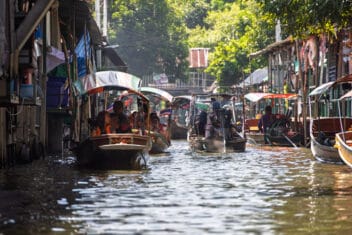
While Damnoen Saduak and nearby Amphawa Floating Markets are very popular, they require a minibus trip out of the city. However, something like Khlong Lat Mayom (Saturdays and Sundays) offers a more local, relaxed experience. It is easily accessible right in the city. My Discover Lesser Known Bangkok Floating Markets post will get you there and back.
The Impossible Market
A day trip to the extraordinary Mae Klong Railway Market is non-negotiable. Here, vendors set up their stalls directly at the side of the train tracks, pulling back their awnings just seconds before the train glides through.

You can reach this market as part of an organized tour in a minibus. Conversely, if you prefer to travel independently, you will find all the details you need in the Mae Klong Railway Market post. The journey itself is an incredible cultural experience. It passes through residential areas, small villages, and dense greenery. Therefore offering a fascinating contrast to the concrete jungle of central Bangkok.
Talat Phlu
Head to the historic Talat Phlu community to enjoy a culinary time capsule of generational, authentic Thai-Chinese cuisine. This area is famed for food stalls that have been running for decades. My Condensed Thonburi Guide will get you there directly.
The dishes on sale are too numerous to list; nonetheless, you might want to try Khao Mu Daeng (Red Pork Rice), Itim Khai Khaeng (Frozen Egg Ice Cream), or Mee Krob (Sweet Crispy Rice Vermicelli). This last one is a legendary dish. It is often prepared using a complex, ages-old recipe which some claim dates back to the reign of King Rama V.
If you prefer, you can combine the Talat Phlu market with a tour of the Great Buddha of Paknam viewpoints.
Tha Prachan Amulet Market
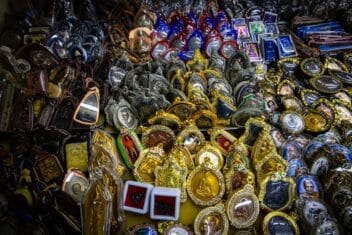
Tucked away near the Grand Palace, the Tha Prachan Amulet Market (often just called the Amulet Market) is a unique cultural experience. Crucially, this is not a market for souvenirs. It is a highly serious commercial hub where devout buyers seek Thai Buddhist amulets for protection, good luck, wealth, or specific blessings.
The marketplace is filled with tiny stalls and magnifying glass-wielding experts. Collectors and laypeople discuss the Buddha or monk images encased in gold or plastic. They evaluate their authenticity, provenance, and the perceived spiritual power imparted by the revered monks who consecrated them.
Visiting here is fascinating. Watch the solemn bartering and the intense study of these tiny sacred objects. As a tourist, it’s a window into the deep-seated faith and specific superstitious practices that underpin daily life in Bangkok. For the location and an interesting walk, see Amulets, Temples, and Ice Cream: Your Guide to Hidden Bangkok’s Itsaraphap.
Night Market Buzz
For the best street food, head to a popular night market like Yaowarat Road and the surrounding lanes in Chinatown. This area comes alive at dusk with endless street stalls on both sides of the road, which is partly closed to traffic. Be warned, it can get busy!
Bangkok’s Rail Heritage
While the modern Skytrain dominates the skyline, the true history of Bangkok’s rail system lies in its older, ground-level lines and iconic stations. Specifically, these routes were the arteries that first connected the Kingdom of Siam. They continue to offer an authentic glimpse into local life.
These walks allow you to get up close and personal with the State Railway of Thailand (SRT):
- Bangkok’s Hidden Rails: A Walk Along Tracks, Canals, and Alleys
- The Saen Saep Canal Walk: Your Guide to Markets, Train Tracks, and Hidden Bangkok
- Authentic Thon Buri Walk: Talat Phlu, Hidden Gems, and the Giant Golden Buddha
Hua Lamphong: The Grand Dame of Thai Railways
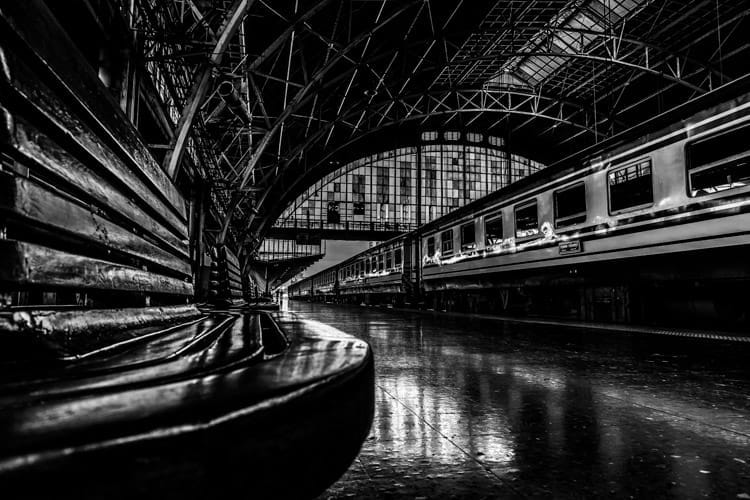
Hua Lamphong Railway Station, officially known as Bangkok Station, is a historical and architectural jewel. Opened in 1916, this station served as the primary gateway to and from the capital for over a century. It is an architecturally significant building. The striking design features a magnificent semicircular facade, a soaring, cast-iron roof, and large stained-glass windows, giving it a distinct neo-Renaissance style.
The role as the main hub for long-distance trains has been phased out, with services shifting to the new Krung Thep Aphiwat Central Terminal. Nevertheless, Hua Lamphong retains a powerful legacy. It still serves certain local and commuter lines and stands as a breathtaking monument to early 20th-century Thai progress. The Guide to Hua Lamphong: The Historic Bangkok Railway Station has all the information you need.
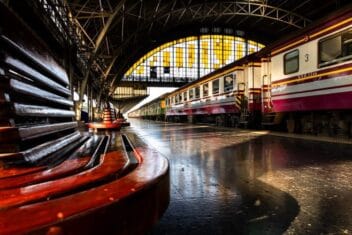
Wongwian Yai and the Local Line to Maha Chai
Travelers must venture across the Chao Phraya River to Wongwian Yai Station to experience the slow, rhythmic pulse of authentic local commuting. All the details are in my Talat Phlu Food Market Walk: Hidden Gems on King Taksin’s Historic Thonburi Trail. Wongwian Yai station is basic, functional, and deeply local. It serves as the terminus for the narrow-gauge line to Maha Chai on the Tha Chin River, the first leg on the train journey to the Mae Klong Railway Market.
Talat Phlu Station: A Gateway to Tradition
The first stop from Wongwian Yai is Talat Phlu Station. Both stations feature in the previously mentioned Talat Phlu Food Market Walk. Talat Phlu literally means “Betel Nut Market.” This reflects the area’s long history as a trading center for betel leaves. The station is directly adjacent to the Talat Phlu community, a wonderfully preserved neighborhood. It is known for its old wooden shophouses, traditional canals, and, as already mentioned, its legendary street food scene.
Stepping off the train here feels like stepping back in time. The area retains its rustic charm, with vendors selling traditional sweets and snacks. Small bridges cross the remaining canals. Overall, it’s a perfect spot to pause, explore an authentic Thai neighborhood, and sample some renowned local desserts.
Echoes of the Past: Hidden Bangkok Gems
While the Grand Palace anchors the current capital, the city’s story truly hinges on the Thonburi side of the Chao Phraya River. This area was the capital for a brief but critical period following the fall of Ayutthaya. Thus, exploring the west bank reveals Bangkok’s resilient past and hidden cultural treasures.
King Taksin and the Thonburi Kingdom
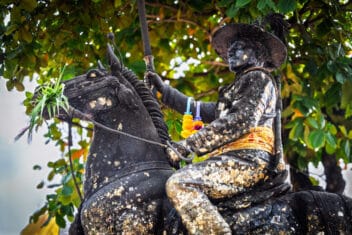
After the destruction of the former Siamese capital, King Taksin (1767–1782) relocated the capital to Thonburi. He oversaw the reconstruction of the kingdom from this strategic location on the west bank of the river.
Wongwian Yai (literally big roundabout or circle) houses the King Taksin Monument near the station of the same name. It is a central point of reverence. It celebrates the King’s military prowess and his role in saving the nation. Navigate through past events with my Talat Phlu Food Market Walk: Hidden Gems on King Taksin’s Historic Thonburi Trail.
The Industrial Heritage of Bangkok
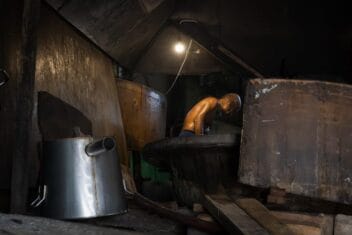
The khlongs of Thonburi were not just waterways; they were arteries sustaining small industries and tight-knit communities. One such business that survives to this day is the Hau Yong Seng Soya Sauce Factory.
Located on the banks of Bangkok Yai Canal, the historic family-run factory stands as a testament to the region’s industrial past. Though modern production is elsewhere, the original site offers a glimpse into the historic manufacturing processes still in use. To find this fascinating factory, see Hau Yong Seng: Exploring Bangkok’s Last Traditional Soy Sauce Factory.
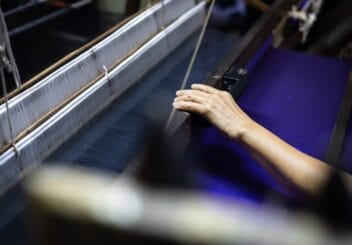
Baan Khrua, a small, traditional Muslim community, is nestled along Khlong Saen Saep. It holds the keys to the modern Thai silk story. Before Jim Thompson popularized the craft internationally, the highly skilled weavers of Baan Khrua were central to the industry.
Follow Baan Khrua: The Authentic Village Behind the Jim Thompson Silk Legacy or The Saen Saep Canal Walk to find the last remaining silk loom in Bangkok.
Khlong Bang Luang and The Artist House
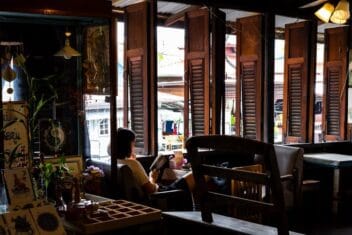
A visit to the Khlong Bang Luang neighborhood is essential for a perfect blend of historic architecture and living culture. Located on the Bangkok Yai canal, the Artist House (Baan Silapin) is a centuries-old wooden house. It has been restored as a community art space. It features art exhibitions, workshops, and craft stalls.
Accessing it by longtail boat emphasizes the area’s canal-side history. Alternatively, The Artist House Bangkok: A Walk Through Historic Khlong Bang Luang is a guided route making the journey an experience in itself. This location provides a tranquil contrast to the bustling city center. It showcases the preservation of folk art and community life in Thonburi.
The Venice of the East: Bangkok’s Waterways
The network of canals and the Chao Phraya River once defined Bangkok, giving rise to the name “Venice of the East”. Sadly, many canals have been filled in. Nevertheless, some waterways still offer a vital, atmospheric alternative to often gridlocked road travel.
Khlong Saen Saep Boat Service
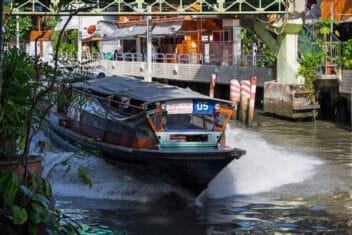
The Khlong Saen Saep Boat Service is used as an express commute by locals. This public transport service is fast, inexpensive, and often thrilling. It cuts through the city center, connecting the Old Town to areas deep in the Sukhumvit district. My Saen Saep Canal Walk ends with a ride on this boat service from Panfa Leelard Pier back to central Bangkok. Be prepared for a basic service and a bit of splashing, but it’s a pure, authentic Thai experience.
Chao Phraya Express Boats
Chao Phraya Express Boats run along a significant length of the river. They are an essential part of the transit system. For tourists, it conveniently connects the Sky Train at Saphan Taksin directly to historic areas like the Grand Palace and Wat Arun. This makes it an excellent, low-cost sightseeing tour in itself.
Additionally, it can be used to start or finish several walking tours to less touristy parts of Bangkok such as the Amulets, Temples, and Ice Cream walk and The Ultimate Walking Guide to Khlong San, Bangkok’s Riverside Gem.
Sacred Sanctuaries: Temples and Buddha
Bangkok is defined by its stunning wats. They are more than tourist attractions; they are active places of worship requiring respectful conduct.
The hugely popular tourist attractions of Wat Arun and the Golden Mountain are certainly worth a visit. Still, to get away from the crowds, there are lesser-known but equally impressive and important sites to see. In some places, you could well be the only foreign visitors there, for example, see the Guide to Hidden Bangkok’s Itsaraphap.
The Great Buddha of Paknam: A Giant on the Thonburi Skyline
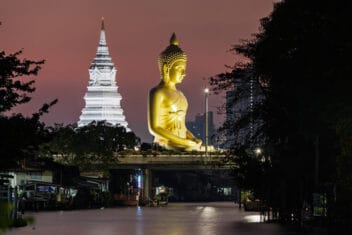
Wat Pak Nam Phasi Charoen is a historic temple. It is located deep in the Thonburi district. It has become a viral sensation thanks to its colossal seated Buddha image, often nicknamed the Great Buddha of Paknam. While the wat itself is very popular, there are many viewpoints of this modern colossus peeking over the houses and canals of the Thonburi area. Furthermore, these viewpoints are less frequented or even known about, except to local Thais.
The Self-Guided Walking Adventure: Golden Buddha to the Tracks features many of these viewpoints. The Great Buddha of Paknam is also included in The Authentic Thon Buri Walk: Talat Phlu, Hidden Gems, and the Giant Golden Buddha In addition it is seen at a distance when following Talat Phlu Food Market Walk: Hidden Gems on King Taksin’s Historic Thonburi Trail.
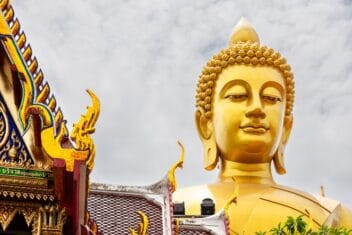
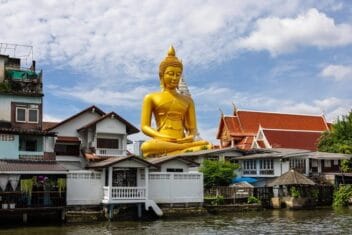
The statue was completed in 2021. It is officially named Phra Buddha Dhammakāya Thepmongkhon. It stands at an astounding 69 meters (226 feet) tall and is 40 meters wide at the base. This makes it the largest Buddha statue in Bangkok, and therefore can be seen from afar. It depicts the Buddha in the meditative posture revered by the Dhammakaya tradition.
Iconic Landmarks: Bangkok’s Architectural and Cultural Highlights
This section highlights some of the most visually striking and historically significant structures that define the Bangkok skyline and its urban identity.
Rama VIII Bridge
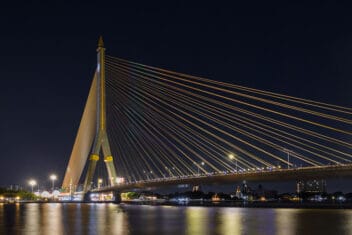
The Rama VIII Bridge is a distinctive asymmetrical, single-pillar cable-stayed bridge spanning the Chao Phraya River. It is a prime location for urban exploration and photography. My Rama VIII Bridge Photo Walk: Your Ultimate Guide to Bangkok’s Iconic Viewpoints will get you to all the best locations.
Hua Lamphong Station
Hua Lamphong, the city’s historic rail gateway, is an architectural landmark that stands as a testament to early 20th-century modernization in Thailand. Its Italian Neo-Renaissance style makes it a unique and captivating structure. My Guide to Hua Lamphong will provide you with valuable insights and tips to help you capture stunning photographs of this architectural marvel.
The Great Buddha of Paknam
A modern addition to the Thonburi skyline, this statue has rapidly become one of the city’s most recognizable icons. It is visible from many locations which I have mapped in Self-Guided Walking Adventure: Golden Buddha to the Tracks.
Restaurants and Cafés: A Culinary Journey
Bangkok is a global food capital. It is recognized with Michelin stars that sit beside world-famous street food carts. Your culinary education is incomplete without sampling the street scene. Look for vendors specializing in one or two dishes, as this indicates mastery. Try the famous Pad Thai from a street cart, a bowl of rich Khao Soi (a northern curry noodle), or the ubiquitous Mango Sticky Rice.
From street food and traditional cafés to high-end restaurants and sky bars, you are spoilt for choice. Instead of trying to catalogue these, what you will find in this blog are simple cafés and restaurants that form part of a route. These offer a chance to relax and unwind. Just about all my routes include at least one café or restaurant; however, here are some of my favourites:
- The delightful Priscilla Ice Cream can be found on the route, Amulets, Temples, and Ice Cream: Your Guide to Hidden Bangkok’s Itsaraphap.
- Karemeen & Sobereen has a fantastic location on the banks of a canal. This cafe is part of The Saen Saep Canal Walk: Your Guide to Markets, Train Tracks, and Hidden Bangkok.
- The unexpected Khun Mai Roti, serving up classic Thai roti, is hidden away in an alley found on Bangkok’s Historic Road: A Journey Along Charoen Krung walk.
Route Collection Map
Pan and/or zoom the map as needed to locate a route, then click on the route line.
Latest Off the Beaten Path Posts
Hidden Bangkok: Wrapping Up
Bangkok is a city that defies simple labels. It’s a sensory feast that will challenge your expectations, reward your curiosity, and etch itself permanently into your memory. From the quiet reverence inside a shimmering wat to the exhilarating roar of a canal taxi speeding down a khlong. Think also of the simple joy of a bowl of street noodles contrasted with the glamorous expanse of a rooftop restaurant. This metropolis is a complex tapestry of ancient history and relentless modernity.
If you want to explore independently, don’t want to be part of a tour, and want to discover in your own time, then join me and explore beyond the typical tourist routes.
Use this guide to navigate your first steps. Then, however, let the spirit of the City of Angels ultimately guide your path. Embrace the chaos, savor the heat, and allow yourself to get wonderfully, authentically lost (but not too lost with my guides!). Because in Bangkok, the greatest adventures are often found where you least expect them.